
After six years of construction, one of the I-70 Mountain Corridor’s largest improvement projects is officially complete – bringing a new climbing lane, safer curves, innovative avalanche protection, wildlife crossings and other improvements to I-70 over West Vail Pass.
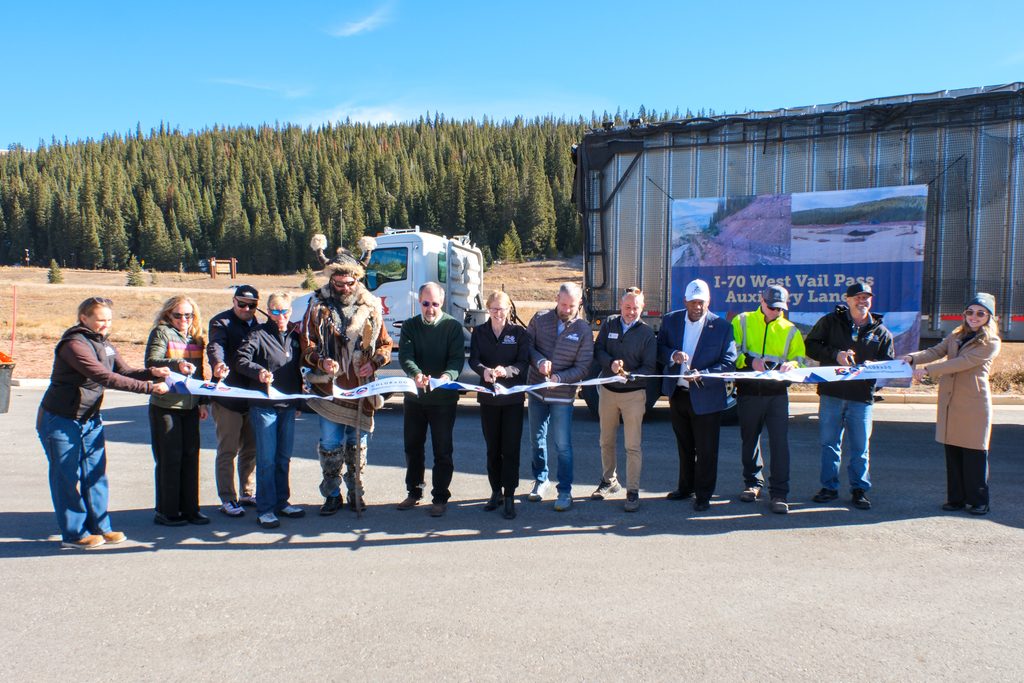
The Colorado Department of Transportation celebrated Monday, Nov. 16, the completion of the $340 million I-70 West Vail Pass Auxiliary Lanes project, which stretches 10 miles from the East Vail Interchange (mile point 180) to the Vail Pass Rest Area (mile point 190).
At more than 10,000 feet in elevation, Vail Pass presents some of the most challenging driving conditions along the I-70 Mountain Corridor. Steep grades, sharp curves, heavy truck traffic, winter weather, avalanches and wildlife all contribute to the complexity of traveling – and maintaining – this critical stretch of interstate.
The newly completed improvements are designed to address many of those challenges, making travel safer and more reliable while protecting the surrounding mountain environment.
One of the biggest changes motorists will notice is a new continuous third eastbound I-70 climbing lane between mile point 187 and the summit of Vail Pass (mile point 190). The additional lane provides more room for slow-moving trucks and other vehicles climbing the steep grade, helping separate heavy vehicles from faster-moving passenger vehicle traffic and reducing crashes associated with significant differences in vehicle speeds.
Drivers will also encounter a smoother alignment near mile point 185, where two bridges were reconstructed and sharp curves were softened. The new bridges are designed for a 100-year service life and were shifted north to help protect nearby Polk Creek.
But some of the Project’s biggest improvements may not be as obvious from behind the wheel.
Near an area known as the “Narrows” at mile point 186, CDOT installed Colorado’s first-of-its-kind passive avalanche and rockfall mitigation system. The system allows CDOT and the Colorado Avalanche Information Center to safely monitor and manage active avalanche paths while reducing the need for extended highway closures and detours for avalanche control work.
A new overhead variable message sign near the narrows also gives CDOT another tool to communicate lane closures, changing conditions and other important information to motorists. Crews installed fiber-optic infrastructure throughout the corridor to support Intelligent Transportation Systems, including variable speed limit signs, weather sensors and automated traffic management.
The improvements also extend beyond motorists.
Five new wildlife underpasses – two large crossings and three designed for small- to medium-sized animals – were constructed under I-70 between mile points 187 and 190. Combined with wildlife fencing, the crossings reconnect important high-country habitat for animals including Canada lynx, elk, moose and deer. The system is projected to reduce wildlife-vehicle collisions in the area by 80 to 90 percent.
The Vail Pass Recreation Path was also relocated farther from the interstate between mile points 185 and 187, creating a safer and smoother experience for cyclists and other trail users. Nearby, CDOT partnered with the U.S. Forest Service to expand trailhead parking along Bighorn Road in East Vail, improving access to the popular Gore Lake and Deluge Lake trailheads and reducing parking conflicts along the recreation path.
For commercial drivers, the Project reconstructed the emergency truck ramp just east of West Vail at mile point 182, providing a straighter entry path designed to reduce the risk of runaway truck rollovers. The ramp also includes a hazardous materials settlement basin to help protect Gore Creek and local water resources.
Commercial truck parking near the summit was expanded as well, giving drivers more space to safely stop, rest and prepare for changing mountain conditions.
Environmental improvements were incorporated throughout construction. Upgraded sediment-control basins help capture winter traction sand and highway runoff before it reaches Gore Creek and Polk Creek, protecting important trout and aquatic insect habitat. Crews also repurposed excavated rock and soil from construction for improvements such as the expanded trailhead and truck parking areas rather than hauling all of the material away.
The $340 million project was funded through a combination of a $60.7 million federal Infrastructure for Rebuilding America grant, state matching funds and Federal Highway Administration program allocations. CDOT worked alongside numerous partners, including FHWA, Kiewit Infrastructure Co., the U.S. Forest Service, Colorado Parks and Wildlife, the Colorado Avalanche Information Center, Eagle County, the Town of Vail and the I-70 Coalition.
While the construction cones may be disappearing, the benefits are designed to last for decades.
Whether you’re heading over Vail Pass for a ski day, traveling between mountain communities or moving goods across Colorado, the improvements are intended to make one of the I-70 Mountain Corridor’s most challenging stretches safer, more resilient and more reliable – in every season.